SALTORA operates under strict international food safety, religious dietary, and export frameworks. Every production run is backed by independent laboratory Certificate of Analysis (COA) reports, providing global importers with absolute chemical and microbiological certainty.
Browse our full suite of food safety certifications, dietary credentials, and laboratory testing protocols. Filter by regulatory domain or search by specific standard.
No compliance document matched your search query. Try broadening your terms or clear the filter.
From geological extraction deep inside the Khewra Salt Range to maritime container stuffing, every batch follows an uncompromising 5-step quality audit.
Hand-selected raw boulders from deepest Khewra geological strata, verified for natural mineral richness and zero surface run-off contamination.
Automated high-resolution optical cameras detect and reject dark clay impurities, followed by closed-circuit demineralized brine wash and hot-air drying.
Rotary vibrating stainless steel screens classify grains into calibrated particle sizes (0.2mm flour up to 8mm crystal rock) with tight tolerance.
Every batch undergoes atomic absorption spectroscopy to verify ≥ 98.5% NaCl purity and ensure toxic heavy metals remain strictly non-detectable.
Salt passes through 10,000 Gauss rare-earth magnetic grates and inline metal detection before hermetic sealing in food-grade moisture barrier packaging.
Comparison of international Codex Alimentarius regulatory thresholds against verified composite laboratory results of SALTORA export food-grade pink salt.
| Chemical Parameter | Codex CXS 150:1985 Limit | SALTORA Typical Analysis | Testing Methodology | Compliance Verdict |
|---|---|---|---|---|
| Sodium Chloride (NaCl) | ≥ 97.0% (Dry Basis) | 98.8% - 99.2% | Potentiometric Argentometric Titration (ISO 2481) | Surpasses Standard |
| Moisture Content (H₂O) | ≤ 0.50% | 0.08% - 0.18% | Gravimetric Oven Drying at 110°C (ISO 2483) | Ultra Dry / Stable |
| Water Insoluble Matter | ≤ 0.50% | 0.10% - 0.15% | Membrane Gravimetric Filtration (ISO 2479) | Pass |
| Lead (Pb) | Max 2.00 mg/kg | < 0.10 mg/kg (Safe) | ICP-MS Spectrometry (AOAC 999.11) | 95% Below Limit |
| Arsenic (As) | Max 0.50 mg/kg | < 0.05 mg/kg (Safe) | Hydride Generation ICP-MS (AOAC 986.15) | 90% Below Limit |
| Cadmium (Cd) | Max 0.50 mg/kg | < 0.02 mg/kg (Safe) | Graphite Furnace AAS (ISO 17378) | Non-Detectable |
| Mercury (Hg) | Max 0.10 mg/kg | < 0.01 mg/kg (Safe) | Cold Vapor Atomic Absorption (AOAC 971.21) | Non-Detectable |
| Essential Trace Elements | Natural Rock Origin | Calcium (Ca), Magnesium (Mg), Potassium (K), Iron (Fe) | Multi-element ICP-OES (EPA 6010D) | 84+ Bioactive Minerals |
Official Batch COA: We issue a container-specific analytical report certified by PCSIR or certified independent labs with every commercial maritime export invoice.
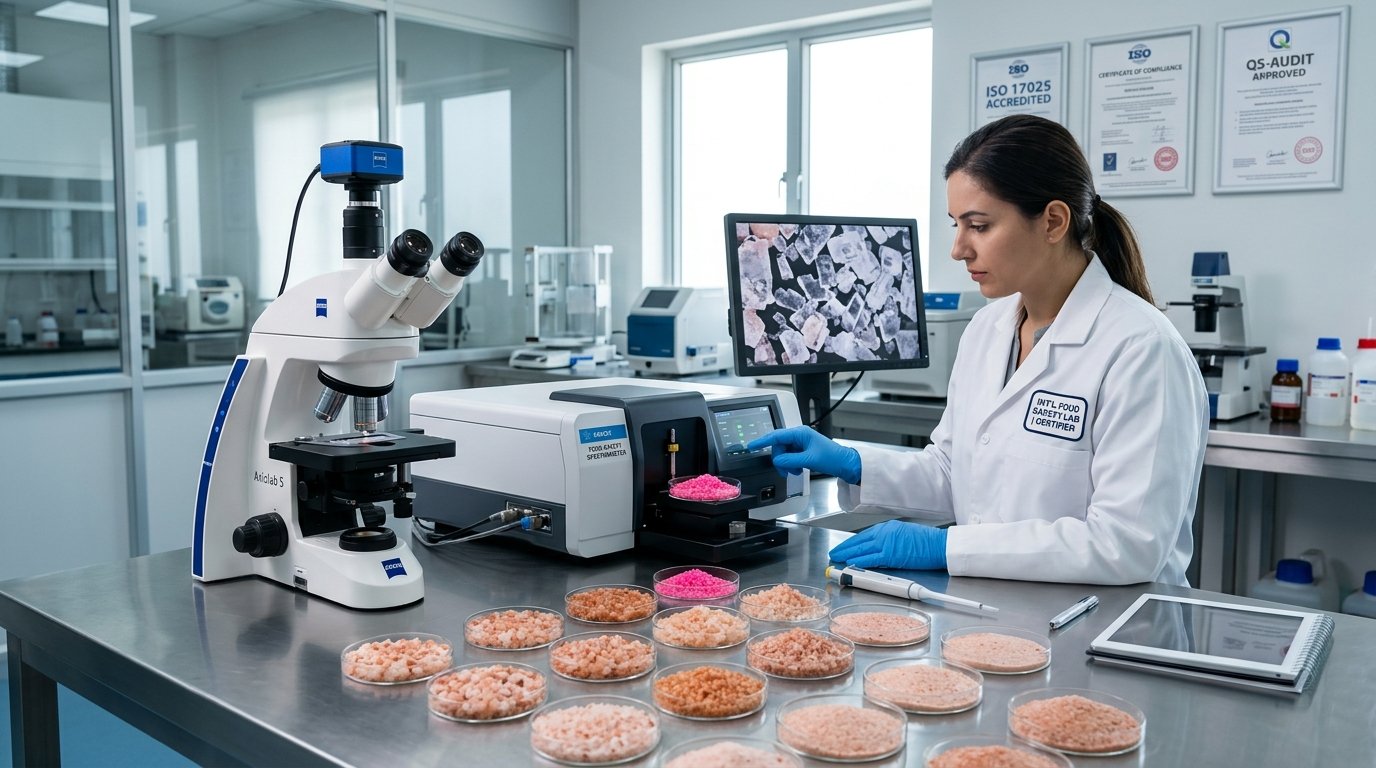
Behind every ton of export salt is rigorous laboratory validation and sanitized clean-zone packaging machinery.
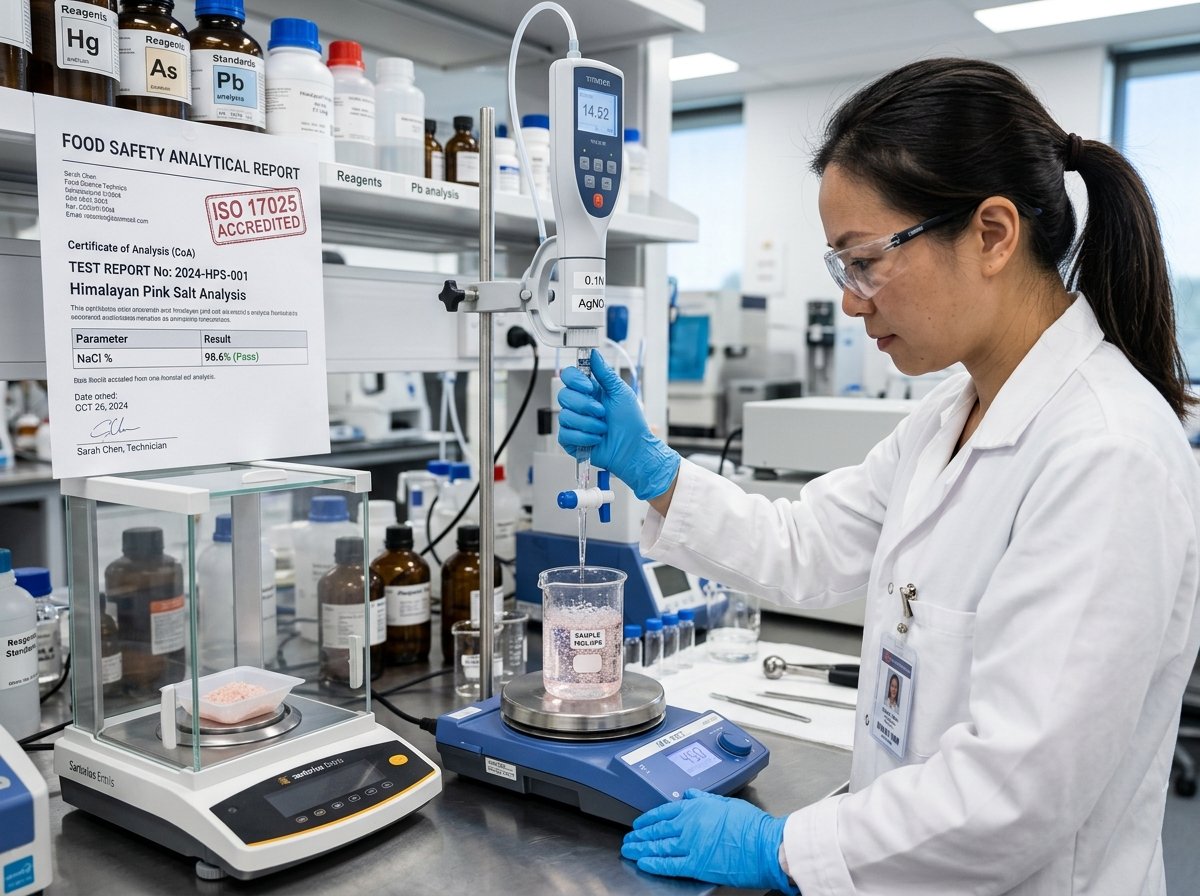
Food science specialists verify batch-specific purity, moisture levels, and trace mineral distribution using atomic absorption titration equipment prior to bagging.
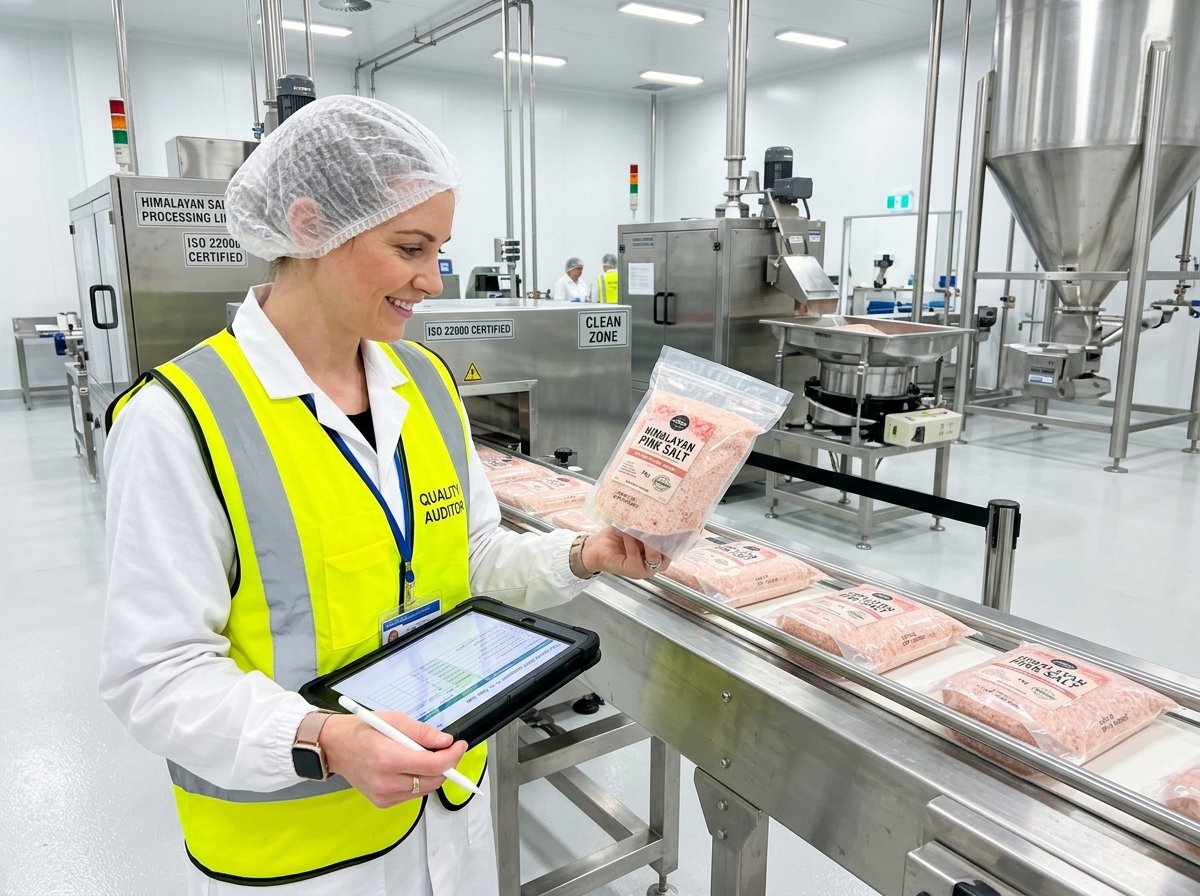
Automated form-fill-seal packaging occurs inside sanitized clean zones with continuous metal detector screenings, magnetic filtration, and weight tare checks.
We welcome buyer-appointed international inspection agencies to conduct container stuffing supervision, draft surveys, composite sampling, and sealed container dispatch.
Everything you need to know about our audit standards, laboratory COAs, and international customs clearance documentation.
Contact our compliance team to receive high-resolution certified copies, laboratory analyses, and proforma documentation for import tenders.